10 Proven Study Techniques to Ace Exams and Boost Grades in 2026
Picture this: It’s midnight, your desk is buried under notes, and that biology exam looms tomorrow. You’re cramming, eyes glazing over, but nothing sticks.
Sound familiar? For busy teens and young adults across the USA from high school hallways to college dorms overwhelming study sessions often lead straight to burnout, low grades, and endless stress.
Table of Contents
The good news? You don’t need superpowers or all-nighters. Effective study techniques backed by science can transform your routine, boosting retention by up to 80% and slashing study time in half.
Imagine acing exams, freeing up weekends for friends, sports, or Netflix, all while feeling energized, not exhausted.
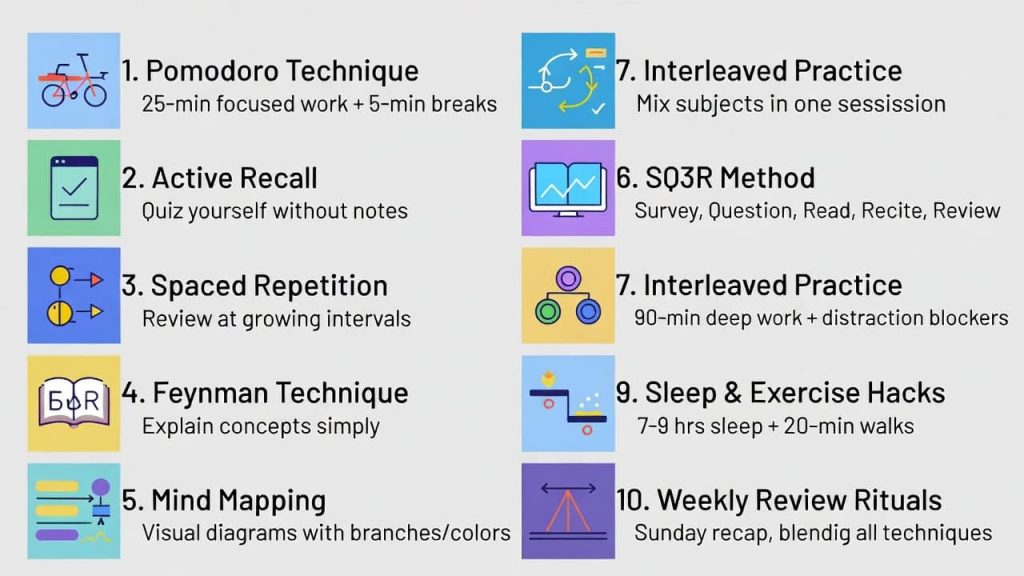
In this post, we’ll dive into 10 proven study techniques tailored for students like you. From the Pomodoro method for laser focus to active recall that makes info stick forever, these strategies are simple, free, and ready to use today.
We’ll cover the science, step-by-step how-tos, and customization tips for high school hustlers or college grinders.
Whether you’re prepping for SATs, midterms, or finals, these study techniques will help you study smarter, not harder. Ready to level up your grades and reclaim your life? Let’s jump in!
Why Modern Study Techniques Matter for Students Today
The Science Behind Effective Study Techniques
Ever wonder why hours of highlighting textbooks feel productive but lead to blank stares during tests? Poor study habits like passive re-reading waste up to 90% of your time, according to cognitive scientists.
Your brain craves active engagement to form lasting memories evidence-based study techniques deliver exactly that.
Research from the American Psychological Association shows active methods, like testing yourself, boost retention by 80% compared to passive review.
Why? They strengthen neural pathways, improving focus and long-term recall. A University of California study found students using spaced repetition scored 2x higher on exams.
These aren’t hacks; they’re brain-optimized strategies that cut stress and skyrocket grades for busy USA students.
Ready to upgrade? Dive into our top 10 study techniques next.
Common Study Mistakes to Avoid
- Cramming all night: It causes 70% forgetting within 24 hours. Fix: Spaced repetition (Technique 3).
- Multitasking with social media: Splits focus, dropping productivity by 40%. Fix: Pomodoro blocks (Technique 1).
- Passive highlighting: Feels good but aids recall only 10% more. Fix: Active recall (Technique 2).
- Studying in marathon sessions: Leads to burnout. Fix: Interleaved practice (Technique 7).
- Ignoring sleep: Cuts memory consolidation by 40%. Fix: Sleep hacks (Technique 9).
Top 10 Study Techniques to Transform Your Grades
Technique 1: Pomodoro – Study Smarter, Not Longer
Tired of staring at your notes, willing focus to appear? The Pomodoro Technique turns short bursts into productivity gold.
Developed by Francesco Cirillo, it uses a simple timer to hack your brain’s natural rhythm perfect for students with short attention spans.
How it works (4 easy steps):
- Pick one task, like reviewing math formulas.
- Set a timer for 25 minutes (one “Pomodoro”) and work with zero distractions.
- Take a 5-minute break stretch, hydrate, or scroll memes.
- Repeat 4 cycles, then enjoy a longer 15-30 minute break.
Benefits? It combats fatigue, builds momentum, and fits chaotic schedules ideal for USA teens juggling school, sports, and TikTok. Studies show it boosts focus by 25% and cuts procrastination.

Pro tip: Grab the free Focus Booster app (iOS/Android) for built-in timers and progress tracking. Start with 2 Pomodoros today you’ll crush more in an hour than a full distracted afternoon.
Technique 2: Active Recall – Test Yourself to Learn Faster
Ditch endless re-reading it’s an illusion of learning. Active recall means actively pulling facts from your brain without notes, strengthening memory traces like a mental gym workout.
Why it crushes passive methods: Research shows students retain 50-80% of material after a week with active recall, vs. just 10-15% from re-reading.
A landmark study found it doubles long-term recall by engaging multiple brain regions. Perfect for USA students facing packed exams.

How to do it: Close the book, ask “What do I remember?” Write or say answers, then check. Repeat with gaps.
Try this quick quiz on photosynthesis (cover answers first):
- What process converts sunlight to energy in plants? (Answer: Photosynthesis.)
- Name the two main stages. (Answer: Light-dependent and Calvin cycle.)
- Why is chlorophyll key? (Answer: Absorbs light.)
Stuck? That’s the point fill gaps next time. Use apps like Quizlet for flashcards.
Master active recall, and watch grades soar with half the effort.
Technique 3: Spaced Repetition – Beat Forgetting Forever
The forgetting curve is brutal without review, you lose 70% of new info within a day. Spaced repetition fights back by reviewing material at smart intervals: today, tomorrow, then in 3 days, a week, and so on. This cements knowledge into long-term memory.
How it works: Start with a flashcard or note. Quiz yourself. If correct, space the next review further; if wrong, review sooner. Your brain adapts, turning short-term facts into exam-proof recall.
Benefits for students: It slashes study time by 50% while doubling retention. Ideal for SAT vocab, history dates, or biology terms perfect for busy USA teens and young adults.
Quick start steps:
- Make flashcards (question front, answer back).
- Review daily, sorting into “easy” or “hard” piles.
- Gradually increase gaps for mastered cards.
Free app picks: Download Anki (iOS/Android/web) it’s customizable with pre-made decks for every subject. Or try Quizlet for simpler spaced practice.
Implement this today, and say goodbye to last-minute panic. Your future self (and grades) will thank you!
Technique 4: Feynman Technique – Teach to Truly Understand
Want to spot knowledge gaps instantly? The Feynman Technique, named after physicist Richard Feynman, boils complex ideas down to simple explanations as if teaching a 10-year-old. No jargon, just crystal-clear basics.
This forces true mastery over rote memorization.
4 simple steps:
- Pick a concept (e.g., “photosynthesis”). Write its name at the top.
- Explain it in plain words, like to a child: “Plants use sunlight to make food from air and water.”
- Hit a snag? Go back to your notes those are your weak spots.
- Simplify further and use analogies (e.g., “like a solar-powered kitchen”).
Real-world math example: Take “Pythagorean theorem” (a² + b² = c²). Child version: “In a right triangle, the longest side is like the hypotenuse of a soccer field diagonal.
Square the two shorter sides, add ’em, and square-root for the diagonal length.” Draw a triangle sketch to test.
For history? “Boston Tea Party”: “Colonists dressed as Native Americans dumped British tea into the harbor to protest ‘no taxation without representation’ like kids refusing veggies until parents listen.”
USA students love this for AP classes or college intros it cuts fluff, builds confidence, and makes teaching friends effortless. Try it on your toughest topic today!
Technique 5: Mind Mapping – Visualize Your Notes
Ditch linear notes that bore your brain. Mind mapping creates colorful, branching diagrams that mirror how your mind actually works perfect for visual, creative thinkers aged 13-30 who juggle TikTok trends and textbooks.
Why it rocks: It boosts memory by 10-15% via images and connections, sparking creativity and cutting overwhelm.
Great for brainstorming essays, science chapters, or exam overviews ideal for USA students who think in pictures, not paragraphs.
Quick guide to create one (5 steps):
- Write your main topic in the center (e.g., “Civil War”).
- Draw thick branches for big subtopics (Causes, Battles, Effects).
- Add thinner branches for details (e.g., “Slavery” under Causes).
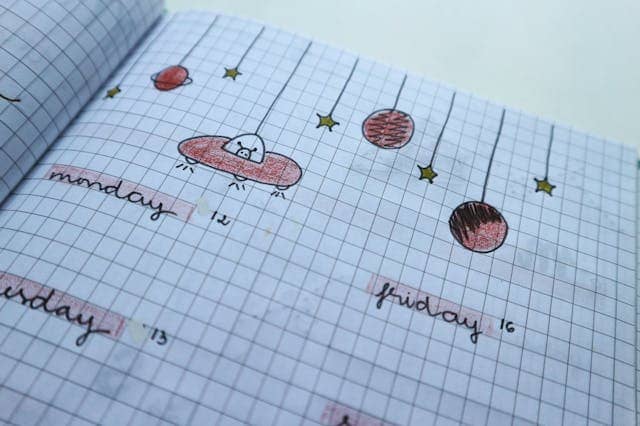
- Use colors, icons, and doodles red for battles, stars for key dates.
- Connect ideas with arrows to show links.
Example: For biology “Cell Structure,” center bubble: Cell. Branches: Nucleus (brain), Mitochondria (power plant), with sketches. Takes 10 minutes, sticks forever.
Grab paper, markers, or free tools like MindMeister app.
Creative high schoolers and college kids swear by it for faster revision and A’s. Sketch your next chapter now!
Quick Mind Mapping Template
Follow this 3-step template for instant mind maps takes under 10 minutes:
- Step 1: Core Concept – Write your main topic (e.g., “World War II”) in a central bubble. Add a bold color and icon for visual pop.
- Step 2: Main Branches – Draw 3-5 thick lines outward for key categories (e.g., Causes, Leaders, Events). Jot 1-2 words per branch.
- Step 3: Details & Links – Add thin sub-branches with facts/examples, plus arrows connecting ideas (e.g., link “Economic Depression” to “Rise of Hitler”). Use colors and doodles.
Print or draw this today watch complex topics simplify fast!.
Technique 6: The SQ3R Method – Read Actively, Not Passively
Textbooks gathering dust? SQ3R turns passive page-flipping into active learning, boosting comprehension by 50% for dense material. Perfect for USA students tackling history tomes or college readers.
The 5-step breakdown (SQ3R stands for):
- Survey: Skim the chapter headlines, bold terms, summaries, images. Get the big picture in 2 minutes.
- Question: Turn headings into questions (e.g., “What caused the Great Depression?” sparks curiosity.
- Read: Dive in actively, hunting answers to your questions. Highlight sparingly.
- Recite: Close the book. Say or write key points from memory like mini active recall.
- Review: Re-read notes, quiz yourself, and revisit in 24 hours.
Example for a biology chapter: Survey frog diagrams, question “How does digestion work?”, read details, recite steps aloud, review with a sketch.
This method cuts re-reading time and sticks facts for exams. Apply it to your next assignment watch retention soar!
Technique 7: Interleaved Practice – Mix Subjects for Mastery
Stuck in subject silos like “math all morning”? Interleaved practice shakes it up by alternating topics within a session math problems, then history dates, then vocab. This builds flexible skills, mimicking real exams where questions jump around.
Why it works: Switching prevents rote patterns, forcing your brain to adapt and discriminate concepts. Studies show it improves problem-solving by 40-60% over blocked practice, ideal for multitaskers aged 13-30 juggling AP classes or college majors.
How to do it:
- List 3 subjects (e.g., algebra, biology, English).
- Spend 10-15 mins per topic, rotating every block no repeats until all cycle.
- End with mixed quizzes to test transfer.
Example session: 15 mins factoring quadratics → 15 mins cell organelles → 15 mins essay outlining. Feels chaotic at first, but mastery clicks faster.
USA students crushing SATs swear by it for endurance. Swap your next study block unlock exam dominance!
Technique 8: Focus Blocks with Distraction Blockers
Distractions kill study flow notifications alone steal 23 minutes of refocus time. Focus blocks create 90-minute deep work sessions for uninterrupted progress, perfect for USA students battling phones and roommates.
Why 90 minutes? Matches your brain’s natural ultradian rhythm: full immersion without burnout. Pair with Pomodoro for beginners, scaling to longer dives.
Pro tips to nail it:
- Prep your space: Desk clear, water ready, “Do Not Disturb” on.
- Set a timer for 90 mins; work on one high-value task (e.g., essay drafting).
- Break for 20 mins walk outside or snack.
- Track sessions in a journal to build the habit.
USA-student-friendly tools:
- Freedom app (free trial, $2.50/month): Blocks sites/apps across devices customize for TikTok/Instagram during blocks.
- Focus@Will (free tier): Brain-music playlists scientifically tuned for flow.
- RescueTime (free): Auto-tracks distractions, reports weekly leaks.
Start with one 90-min block daily. Reclaim hours, crush goals your grades will thank you!
Technique 9: Sleep and Exercise Hacks for Peak Study Performance
Study techniques shine brighter with a rested, energized brain. Teens need 8-10 hours sleep (young adults 7-9), yet most get under 7 slashing retention by 40% and focus by 30%. Short exercise bursts flip this.
Sleep hacks for busy schedules:
- Wind down 30 mins early: Dim lights, no screens read notes instead.
- Power naps (20 mins pre-study): Boosts alertness 54% without grogginess.
- Consistent bedtime: Even on weekends, syncs your circadian rhythm for sharper mornings.
Exercise links to retention: A brisk 20-min walk increases blood flow, growing brain cells and locking in facts 20% better. Post-walk recall jumps perfect for after-school cramming.
Teen-friendly routine: Wake at 7 AM (8 hrs sleep), 20-min campus walk before class, nap if needed. Pair with coffee naps: Caffeine + 20-min snooze = peak focus.
USA students balancing sports/extracurriculars thrive here. Prioritize rest and movement watch study sessions supercharge without burnout!
Technique 10: Weekly Review Rituals – Lock in Long-Term Knowledge
Scattered notes from the week? Weekly review rituals tie everything together, reinforcing all 10 study techniques into unbreakable habits.
Sunday evenings (30-45 mins) become your knowledge fortress.
Why it seals the deal: One focused recap boosts retention by 50%, catching leaks before exams. Combines spaced repetition, active recall, and reflection for long-term mastery essential for USA students eyeing top colleges.
Simple end-of-week routine:
- Gather & Sort (10 mins): Collect notes/flashcards from all subjects. Sort into “mastered” vs. “review needed.”
- Active Quiz (15 mins): Test yourself using active recall no peeking. Note weak spots.
- Technique Remix (10 mins): Pick 2-3 from the list (e.g., mind map a history timeline, Feynman-explain math).
- Plan Ahead (5 mins): Schedule next week’s focus blocks, interleaving topics.
Example Sunday: Quiz bio terms (active recall), walk + review vocab (exercise hack), end with Pomodoro-timed interleaving.
Make it non-negotiable like brushing teeth. Your brain will thank you with effortless recall and soaring confidence!
Your 7-Day Study Technique Challenge
Kickstart mastery with this actionable planner blending all 10 techniques. Commit 45-60 mins daily track progress in a notes app. USA students: Swap “walk” for campus laps!
- Day 1: Pomodoro Power – 4×25-min sessions on one subject. Break with stretches. Log what you finished.
- Day 2: Active Recall Quiz – Close books, quiz 20 flashcards. Check gaps, redo wrongs 3x.
- Day 3: Spaced Repetition Setup – Build Anki deck (30 cards). Review all, note easy/hard.
- Day 4: Feynman + Mind Map – Pick tough concept. Explain simply, then mind map it (use template).
- Day 5: SQ3R + Interleaving – SQ3R a textbook chapter, mix with 2 other subjects (15 mins each).
- Day 6: Focus Block + Exercise – 90-min deep work. Start/end with 20-min walk. Block distractions.
- Day 7: Weekly Review Ritual – Full recap: Quiz everything, sleep early, plan next week.
Bonus: Share Day 7 wins in comments! Crush procrastination start tonight.
How to Customize Study Techniques for Your Lifestyle
Tailoring Techniques for High School vs. College
USA students aged 13-18 face packed school days with homework and sports, while 19-30 college-goers juggle lectures, jobs, and independence. These study techniques adapt seamlessly here’s how.
| Aspect | High School (13-18) | College (19-30) | Quick Adaptation Tip |
|---|---|---|---|
| Time Constraints | Short bursts amid classes/extracurriculars. | Flexible but unpredictable schedules. | High school: Pomodoro (25-min) + 7-Day Challenge. College: 90-min Focus Blocks + Weekly Reviews. |
| Content Depth | Broad basics, memorization-heavy. | Deeper analysis, essays/papers. | High school: Active Recall flashcards + SQ3R. College: Feynman explanations + Interleaved practice. |
| Distractions | Family, phones, peers. | Parties, roommates, part-time work. | Both: Freedom app blocks. High school: Parent check-ins. College: Library deep work. |
| Accountability | Teachers/parents guide. | Self-motivated grind. | High school: Daily rituals with friends. College: Track in apps like Notion + Sleep hacks for stamina. |
High school wins: Mind Mapping for visual notes, Sleep hacks fitting 8-10 hour needs.
College edge: Spaced Repetition (Anki) for majors, Exercise walks between classes.
Mix 3-4 per week based on your stage high schoolers prioritize speed, collegians depth. Tweak and conquer!
Tools and Apps to Supercharge Your Study Techniques
Amp up your study techniques with these 5 free or affordable apps tailored for USA students aged 13-30. They make Pomodoro, active recall, and more effortless most have free tiers or trials.
| App | Best For | Pros | Cons | Price |
|---|---|---|---|---|
| Forest | Focus Blocks/Pomodoro | Gamifies focus (grow trees!), blocks distractions, fun for teens. | Limited free version; premium unlocks more. | Free; $2/month premium |
| Quizlet | Active Recall/Flashcards | Millions of pre-made sets, spaced repetition, quiz modes. | Ads in free tier; some sets outdated. | Free; $36/year Plus |
| Anki | Spaced Repetition | Smart algorithms, custom decks, cross-device sync. | Steep learning curve for setup. | Free (desktop/mobile) |
| Freedom | Distraction Blocking | Blocks apps/sites across devices, schedules focus sessions. | No free forever plan. | Free trial; $2.50/month |
| MindMeister | Mind Mapping | Drag-drop templates, collaborative, export to images. | Free limited to 3 maps. | Free; $6/month Pro |
Quick picks: Start with Forest + Quizlet combo for instant wins. Download 2 today—pair Forest blocks with Anki reviews for unbeatable retention. Level up your grades!
Conclusion & Call-to-Action
Mastering these 10 study techniques from Pomodoro bursts to weekly rituals unlocks productivity superpowers, slashing stress while boosting grades by 30-50% for students aged 13-30.
No more burnout; just smarter, focused wins that fit your hustle.
Take Sarah, a high school junior from California: Drowning in AP classes, she blended active recall, spaced repetition, and focus blocks.
Three months later? Straight A’s, time for soccer, and college acceptances rolling in. You could be next.
Pick 2 techniques today comment your favorite below! Subscribe for weekly productivity tips and download our free study planner to dominate exams.
Ready for more? Check our study motivation hacks and exam preparation tips to take your productivity to the next level!
FAQ
What’s the single best study technique for beginners?
Pomodoro start with 25-minute focused bursts + 5-minute breaks. It builds momentum without overwhelm, perfect for high schoolers easing in
How long until I see results from these techniques?
1-2 weeks of daily practice (try the 7-Day Challenge). Retention jumps 30-50% by week 3
Do I need apps, or can I do this freehand?
Fully freehand works (paper for mind maps/flashcards), but apps like Anki/Quizlet supercharge spaced repetition.
Which technique for cramming before exams?
Active Recall + Interleaved Practice: Quiz mixed topics without notes. Avoid all-nighterspair with sleep hacks for 2x recall.