Which Crisis Stage Includes the Person Following Normal Daily Routines
You Look Fine. But Something Feels Off.
The alarm goes off. You get up, brush your teeth, make coffee, and head out the door. From the outside, everything looks completely normal. But somewhere between waking up and starting your day, you realize none of it feels like anything anymore.
Table of Contents
You’re doing everything you’re supposed to do. Classes, work, meals, sleep. Repeat. And yet something feels hollow, like you’re watching your own life through a window instead of actually living it.
If that sounds familiar, you might be experiencing something that a lot of people go through but very few actually recognize.
Psychologists call it the resolution stage of a crisis, and it’s the exact answer to a question many people search for but rarely get a straight response to: which crisis stage includes the person following normal daily routines?
The short answer? It’s the final stage of a personal crisis and it’s far more complicated than it looks. Because just because you’re functioning doesn’t mean you’re fine.
And when you’re not truly fine, your productivity, your focus, and your sense of purpose all quietly start to suffer.
In this article, you’ll learn exactly which crisis stage involves returning to normal routines, why it can secretly stall your growth, and most importantly what you can do to move from just going through the motions to actually thriving again.
What Is a Personal Crisis? (And Why It’s Not Always Obvious)
When most people hear the word “crisis,” they picture something big and dramatic a car accident, a sudden loss, a complete breakdown. But the truth is, most personal crises don’t look like that at all.
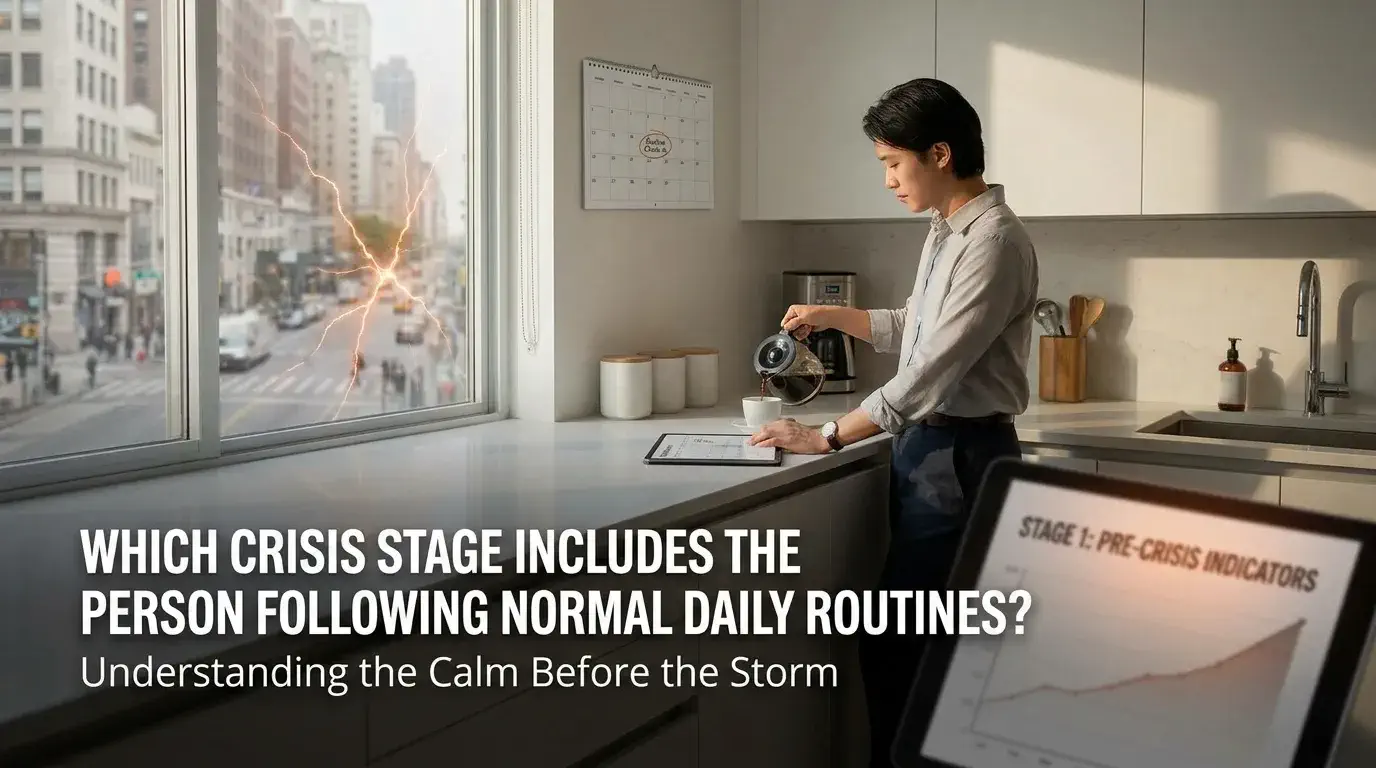
A crisis can be as quiet as failing an exam you studied hard for. It can be a friendship ending without explanation, a job falling through, or just a slow, creeping feeling that your life isn’t going the way you planned. You don’t have to be falling apart on the outside for something serious to be happening on the inside.
In psychology, a personal crisis is simply a point where your usual ways of coping stop working. The stress becomes too much, your normal tools aren’t enough, and your mind and body are forced to find a new way forward.
The good news? Researchers have mapped this process out. And understanding it can help you recognize exactly where you are and what to do next.
“A crisis doesn’t always announce itself. Sometimes it looks like a perfectly normal Tuesday.”
The 7 stages of crisis a simple breakdown
Psychologist Albert Roberts developed one of the most widely used crisis models. Here’s what each stage actually looks like in real life no textbook language, just the honest version.
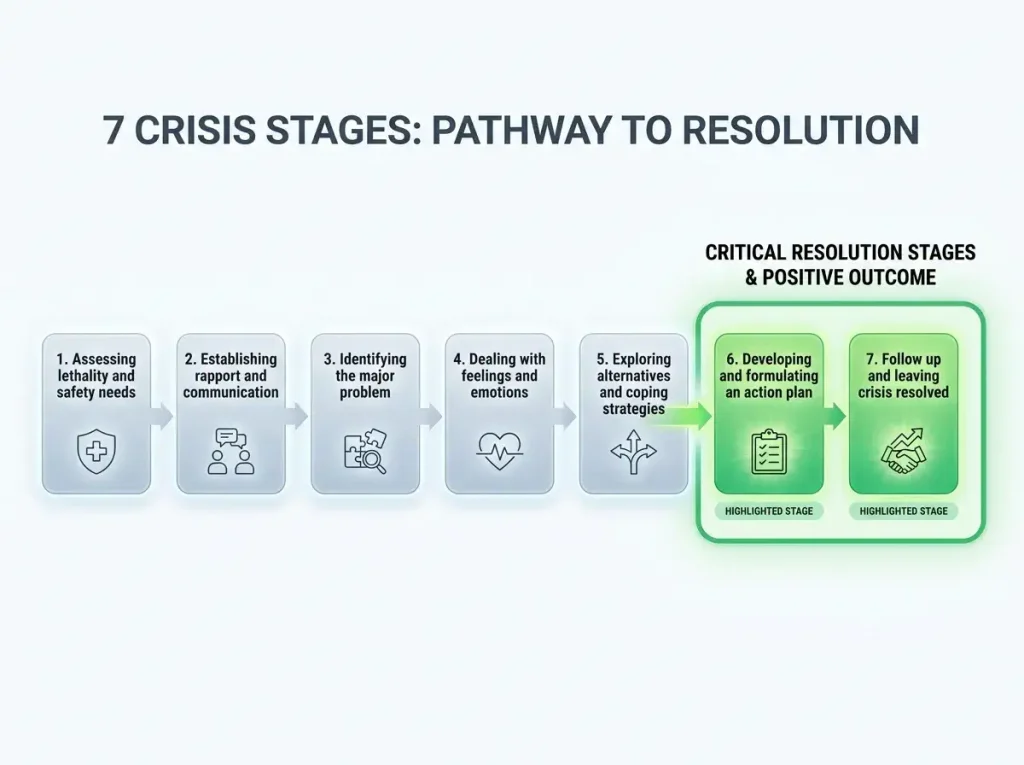
Stage 1 – Assessing the situation (Quiet)
- Something has gone wrong and you know it
- You’re trying to figure out how serious it is
- You haven’t fully reacted yet
Stage 2 – Making contact (Visible)
- You start reaching out to a friend, family member, or even just Googling what you’re feeling
- The need for connection kicks in
- You may not fully understand why yet
Stage 3 – Identifying the major problem (Visible)
- You start to pinpoint what’s actually wrong
- It might not be what you first thought
- Sometimes it’s layereda breakup isn’t just about the relationship, it triggers deeper fears too
Stage 4 – Dealing with feelings and emotions (Visible)
- This is often the most overwhelming stage
- Emotions hit hard anger, sadness, confusion, numbness
- You might cry, shut down, or swing between both
- This is your mind processing what happened
Stage 5 – Exploring coping strategies (Quiet)
- You start problem-solving again
- You’re asking: what are my options? What has helped before?
- This is the turning point you’re no longer just reacting, you’re looking for a way through
Stage 6 – Developing an action plan (Key stage)
- You’ve found a path forward and you’re starting to follow it
- Structure returns, decisions feel easier
- Things begin to stabilize though healing is still very much in progress
Stage 7 – Following up and leaving crisis resolved (Key stage)
- But here’s the thing: normal-looking and fully healed are not always the same
- Life looks normal again from the outside
- Routines are back you’re showing up, going to class, heading to work
That last stage where everything looks fine on the surface is exactly what we need to talk about next. Because this is the stage most people misunderstand the most, and it has a direct impact on your focus, your drive, and your ability to get things done.
Which Crisis Stage Includes the Person Following Normal Daily Routines?
The crisis stage that includes the person following normal daily routines is Stage 7 the Resolution Stage, also called equilibrium restoration. At this point, the person has moved past the emotional peak of the crisis and returned to their regular schedule. They go to class, show up to work, and maintain their daily habits but that doesn’t always mean they’ve fully healed.
This is the stage that catches most people off guard including the person going through it.
From a distance, Stage 7 looks like recovery. And in many ways, it is. The chaos has settled. The worst of the emotional storm has passed. Life has structure again. But structure and healing are two very different things and confusing them is where a lot of people quietly get stuck.
What it looks like outside
- Waking up and following a routine
- Going to class or work on time
- Replying to messages normally
- Eating, sleeping, functioning
- Saying “I’m fine” and meaning it
What’s happening inside
- Feeling detached from everything
- Low motivation with no clear reason
- Going through motions on autopilot
- Avoiding anything that feels hard
- Wondering why nothing excites you
What “restored equilibrium” actually means
The clinical term for Stage 7 is “restored equilibrium” which sounds like everything is back to normal. And technically, it is. Your external life has rebalanced. But equilibrium just means stable, not thriving.
Think of it this way. Imagine your phone after a bad drop. It still turns on. Apps open. Texts send. From the outside, it works perfectly fine. But there’s a hairline crack underneath the screen that you can feel every time you swipe and if you ignore it long enough, it gets worse.
That’s restored equilibrium. Functional on the surface. Still cracked underneath.
Here’s what this actually looks like for someone in their teens or twenties:
Everyday example – college student
Maya went through a tough breakup mid-semester. She cried, struggled to focus, missed a few classes. Then slowly, things settled. She started going back to her routine lectures, gym, dinner with friends. Everyone around her said she seemed “back to normal.” But in class, she was barely retaining anything. At the gym, she was just going through the motions. At dinner, she was present but not really there. That’s Stage 7.
Everyday example – young professional
Jordan lost a job he’d worked toward for two years. After a rough few weeks, he landed something new and jumped straight back in. Schedule sorted. Commute back. LinkedIn updated. But his focus at work was scattered, his enthusiasm was flat, and he kept procrastinating on anything that required real effort. Functioning yes. Healed not quite.
Why this stage is the most misunderstood
Here’s the problem with Stage 7: it’s invisible. And invisible problems are the hardest ones to address.
When you’re clearly in crisis emotional, overwhelmed, visibly struggling people around you show up. They check in. They offer help. But the moment you look okay again, the support tends to fade. And that’s exactly when you need it most.
There are a few dangerous assumptions people make at this stage:
- Routine = recovery just because life looks normal doesn’t mean the emotional work is done
- Functioning = fine showing up is not the same as being fully present
- Time alone heals without reflection or support, Stage 7 can stretch on indefinitely
- Feeling flat is normal low motivation and emotional numbness are not just “part of life”
“The most dangerous place to be in a crisis isn’t the breakdown. It’s the part where you look okay but you’re running on empty.”
And this is where your productivity takes the biggest hit. Not during the obvious hard times but during the stage where everything looks fine, and you can’t quite explain why you still can’t seem to get anything meaningful done.
That’s exactly what we’re going to break down in the next section.
How Normal Daily Routines During a Crisis Quietly Kill Your Productivity
Here’s something nobody tells you about Stage 7 of a crisis: it doesn’t feel like a crisis anymore. And that’s exactly what makes it so damaging to your productivity.
When you’re back in your routine alarm, commute, class, work, sleep, repeat your brain sends a signal that things are okay. But underneath that routine, your mental bandwidth is still recovering. And a recovering mind doesn’t produce its best work. It produces just enough to get by.
Getting by looks productive. It isn’t.
“Busy and productive are not the same thing. During the routine crisis stage, most people are very busy doing very little that actually matters to them.”
Autopilot mode vs. intentional living
There are two ways to move through your day. One builds toward something. The other just fills time.
Autopilot mode
- Completing tasks without thinking about why
- Reacting to whatever comes at you
- Feeling busy but ending the day empty
- Avoiding anything that requires real effort
- Scrolling to fill silence instead of resting
- Saying yes to things to avoid thinking

Intentional living
- Choosing tasks that align with your goals
- Deciding where your energy goes each day
- Feeling tired but satisfied at day’s end
- Leaning into hard things that matter to you
- Resting on purpose, not out of avoidance
- Saying no to protect what counts most
During the routine crisis stage, almost everyone defaults to autopilot. And two things happen as a result both of which destroy your ability to do meaningful work.
Deep work
What it is and why you lose it
Deep work means focused, distraction-free thinking that produces real results a strong essay, a creative solution, a skill you’re actually building. During autopilot mode, your brain skips this entirely. Everything stays surface-level. You do the work, but none of it sticks or compounds.
Decision fatigue
Why choosing anything feels exhausting
Your brain makes hundreds of decisions a day. When you’re in the routine crisis stage, your mental energy is already depleted from the inside so even small decisions feel overwhelming. What to eat, what to work on, whether to reply to that text. All of it feels heavier than it should.
Where it shows up: school, work, and social life
Autopilot doesn’t stay in one area of your life. It spreads. Here’s exactly where you’ll notice it and how to recognize it when you see it.
At school
- Sitting through lectures but retaining almost nothing
- Starting assignments at the last minute not out of laziness, but because nothing feels urgent enough to care about
- Missing deadlines you would normally never miss
- Studying for hours and feeling like you learned nothing
- Avoiding office hours, group projects, or anything that requires showing up mentally not just physically
At work
- Completing tasks on your to-do list but avoiding the ones that actually require thinking
- Procrastinating on emails, projects, or decisions that feel too heavy
- Saying yes to everything because it’s easier than figuring out what actually matters
- Feeling like you worked all day but can’t name a single thing you genuinely accomplished
- Losing interest in work you used to find meaningful or exciting
In social life
- Showing up to hangouts but feeling disconnected the entire time
- Doom-scrolling for hours as a way to avoid being alone with your thoughts
- Canceling plans at the last minute because you just can’t bring yourself to go
- Feeling nothing not sad, not happy, just flat during moments that should feel good
- Smiling and nodding through conversations while your mind is somewhere else entirely
73% of people in the resolution stage of a crisis report significantly reduced motivation and concentration — even after their emotional symptoms have improved. Most never connect it to the crisis at all.
The pattern across all three areas is the same: you’re present, but you’re not really there. You’re doing the thing, but you’re not in it. And the longer this goes on without being addressed, the harder it becomes to shift out of it on your own.
The good news? This isn’t permanent. And it’s not a character flaw. It’s a stage and like every stage, there’s a way through it.
Next up: 7 practical strategies to break out of autopilot mode and rebuild your productivity from the inside out starting today.
7 Ways to Reclaim Your Productivity After the Routine Crisis Stage
Getting out of autopilot mode doesn’t require a complete life overhaul. It starts with small, deliberate shifts ones that signal to your brain that you’re ready to be present again, not just present-looking.
Here are seven things you can start doing right now.
Tips 1–3: Rebuild your environment and schedule
1. Time-block your day even loosely
When everything feels equally unimportant, structure makes decisions for you:
- Pick 2–3 things you actually want to finish today
- Assign each one a specific time slot even just “10am to 11am: finish the report”
- You don’t need a perfect schedule just a starting point that isn’t a blank screen
Try this: the 3-task rule pick just 3 things each morning
2. Reset your workspace physically
Your environment is a direct cue for your brain:
- A cluttered, unchanged desk keeps you mentally stuck in the same place
- Spend 10 minutes clearing your space and opening a window
- Or simply move to a different room or a coffee shop a new environment tells your nervous system it’s safe to focus again
Try this: one surface, cleared completely before you open your laptop
3. Simplify your morning routine ruthlessly
A complicated morning drains your decision-making energy before the day even starts:
- Strip it back to just 3 non-negotiables
- Something that wakes your body up
- Something that feeds it
- Something that takes you away from a screen
- Keep the whole thing under 30 minutes consistency here builds momentum faster than anything else
Try this: wake up → move for 5 mins → eat → start — nothing else
“Your environment is doing half the work or half the damage. In the routine crisis stage, changing your surroundings is one of the fastest ways to interrupt autopilot.”
Tips 4–7: Reset mentally and emotionally
4. Journal for 5 minutes not to be deep, just to offload
You don’t need to write beautifully or figure anything out:
- Open a notes app or a notebook and dump whatever is sitting at the front of your mind
- Worries, random thoughts, things you’re avoiding all of it counts
- This frees up mental bandwidth that autopilot mode keeps locked in the background
- It drains you silently journaling brings it to the surface so it stops running in the background
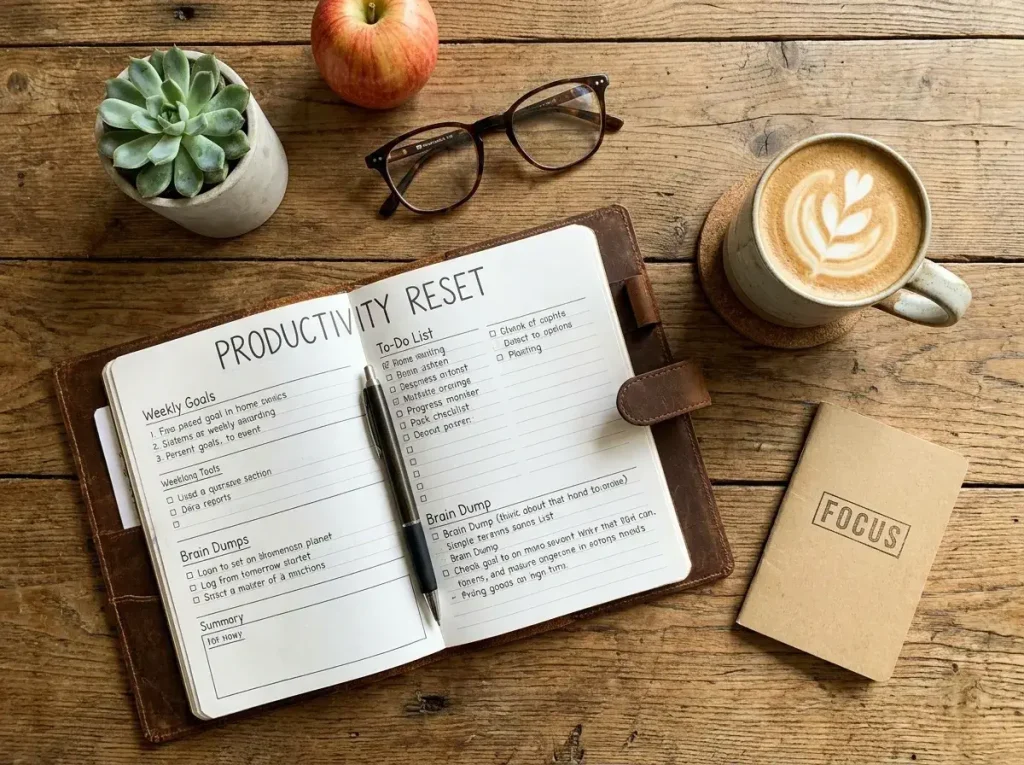
Try this: ask yourself “What’s taking up space in my head right now?” write for 5 mins
5. Set micro-goals not big ones
Big goals feel paralyzing when your motivation is low:
- Instead of “finish my project” try “write the first two sentences”
- Instead of “get my grades up” try “attend every class this week”
- Instead of “get fit” try “walk for 10 minutes today”
- Small wins rebuild the neural pathways for motivation each completed micro-goal makes the next one easier to start
Try this: break any task down until it takes less than 10 minutes to start
6. Do a daily digital detox — even just for one hour
Doom-scrolling is the default escape in Stage 7 and it’s costing you more than you think:
- It fills the silence without asking anything of you
- But it keeps your brain in a constant low-level stress state
- That state makes deep focus nearly impossible even after you put your phone down
- One distraction-free hour a day can meaningfully shift your ability to concentrate
Try this: phone in another room from 8–9pm every night this week
7. Know when to ask for help — and actually do it
Sometimes the most productive thing you can do is admit you’re not okay:
- A therapist, school counselor, or trusted friend can help you process what’s still lingering
- Unprocessed emotions from the crisis quietly drain your energy every single day
- You don’t have to be in crisis mode to deserve support
- Asking for help isn’t a setback it’s the fastest route back to yourself
Try this: one honest conversation this week with anyone you trust
You don’t need to do all seven at once. Pick one from each group one environment shift and one mental reset and start there. Progress in the routine crisis stage isn’t about doing more. It’s about doing things with intention again, even if that intention is small.
Are You Stuck? Signs You Haven’t Actually Left the Crisis Stage Yet
The tricky thing about the routine crisis stage is that it can last weeks — or even months without you realizing it. Life looks normal. You’re functioning. But deep down, something still feels off.
Here’s a simple self-check. Go through the list honestly no judgment, just awareness.
Checklist: Signs you might still be in the routine crisis stage
Ask yourself how many of these sound familiar right now:
- [ ] You complete tasks but feel zero satisfaction when you finish them
- [ ] You’ve lost interest in things that used to genuinely excite you
- [ ] You’re tired even after a full night of sleep
- [ ] Small decisions feel overwhelming or exhausting
- [ ] You’re going through your routine but can’t remember why any of it matters
- [ ] You feel emotionally flat not sad exactly, just… nothing
- [ ] You’re avoiding anything that requires real mental effort
- [ ] You keep procrastinating on things that are actually important to you
- [ ] You feel disconnected from people even ones you care about
- [ ] You’re telling everyone you’re fine, but you’re not sure you believe it yourself
What your results mean:
1–3 boxes checked: You’re likely in recovery and making progress. Keep going with the strategies in Section 4 you’re closer than you think.
4–6 boxes checked: You’re probably still in the routine crisis stage. That’s okay awareness is the first step. Focus on one small shift at a time and consider talking to someone you trust.
7 or more boxes checked: You may need more support than self-help strategies alone can provide and there is absolutely nothing wrong with that. Reaching out to a professional is the strongest, most productive move you can make right now.
You don’t have to figure this out alone
One of the biggest myths about the routine crisis stage is that you should be able to push through it on your own. After all you’re functioning, right? You’re showing up. Surely that’s enough.

It isn’t always. And recognizing that is not weakness. It’s self-awareness which is one of the most underrated productivity skills there is.
Here are some real, accessible resources if you’re based in the US and ready to take that next step:
- Crisis Text Line -Text HOME to 741741. Free, confidential support 24/7. You don’t have to be in crisis to use it it’s for anyone who needs to talk
- BetterHelp – Online therapy that fits around your schedule. Affordable plans available for students and young adults
- Your school or college counselor – Free, on-campus support that most students never use. One appointment can make a bigger difference than you’d expect
- NAMI HelpLine – Call 1-800-950-6264 or text “NAMI” to 741741. Free mental health support and resource navigation across the US
- 7 Cups – Free online chat with trained listeners, available any time. A low-pressure first step if talking to a professional feels like too much right now
Getting support isn’t the end of your productivity story. It’s the part where it actually starts moving forward again.
Conclusion
Let’s go back to where we started.
The alarm goes off. You get up. You go through your day. From the outside, everything looks completely fine.
But now you know something most people don’t that looking fine and being fine are two very different things. And that the crisis stage which includes the person following normal daily routines is one of the most misunderstood, most overlooked, and most productivity-draining experiences a person can go through.
You’re not broken. You’re not lazy. You’re not “just bad at focusing.” You’re in a stage and stages end.
Here’s what you now know:
- The crisis stage that includes following normal daily routines is Stage 7 the resolution stage
- Returning to routine doesn’t automatically mean you’ve healed
- Autopilot mode looks like productivity but quietly drains your focus, motivation, and output
- Small, intentional shifts in your environment and your mindset are enough to start breaking the cycle
- Asking for help isn’t a detour from your progress. It’s the direct route
The one thing to remember
Functioning is the floor not the ceiling.
Just because you’re getting through your days doesn’t mean you have to settle for getting through your days. You’re allowed to want more than that. More focus. More energy. More mornings that actually feel like something.
That starts with one decision: to stop running on autopilot and start doing things even small things with intention again.
You don’t have to overhaul your life today. You just have to pick one thing from this article and actually do it.
One last thing
If this article made you stop and think even for a second that’s not a coincidence. That pause? That moment of recognition? That’s you stepping out of autopilot mode, right now, in real time.
Hold onto that feeling. It’s where everything starts.
FAQ
Which crisis stage includes the person following normal daily routines?
Stage 7 the resolution stage, also called equilibrium restoration. This is where a person returns to their regular schedule and daily habits after a crisis.
How long does the routine crisis stage last?
It varies from person to person. For some it lasts a few weeks, for others it can stretch into months
Can you be productive during the routine crisis stage?
Yes, but it’s usually surface-level productivity. You can complete tasks and meet basic expectations, but deep focus, creativity, and genuine motivation are often significantly reduced.